
A load cell brake measures the force you apply, making it easier to build consistent braking habits than with a pedal that responds only to travel. But the right set depends on more than the sensor: pedal feel, mounting, compatibility, and available space all matter.
These 10 options span established sim-racing ecosystems and more configurable PC-focused setups. Use the comparisons below to narrow your choice before checking the details of each listing.
Best 10 Load Cell Pedals Picks for 2026
Flexible Setup Pick
Logitech G RS Sim Racing Pedals

- 75 kg force load cell brake
- Adjustable positions and stable steel frame
- USB PC connection; console options vary by wheel
Best For: Racers seeking flexible pedal placement and Logitech wheel compatibility
Brake-Tuning Pick

- Up to 90 kg foot force at brake plate
- Tool-free elastomer changes
- Three pedals with Hall-sensor throttle and clutch
Best For: Racers who want an included clutch and adjustable brake feel
Ergonomic Tuning Pick

- 100 kg load cell with sensor fusion
- 25 standard brake-feel configurations
- Adjustable face angle, spacing, and height
Best For: PC racers refining both pedal feel and driving position
PC Rig Durability Pick

- Adjustable load cell brake feel
- Die-cast aluminum; tested to 1,000,000 activations
- PC-only brake-and-throttle set
Best For: PC rig owners prioritizing durability and adjustable resistance
Single-Pedal Option

- Listed as a load cell pedal
- Item model says “1 pedal”
- Compatibility details not supplied
Best For: Buyers checking a MOZA CRP2 single-pedal listing
PC Tuning Pick
- Stated 200KG load cell brake
- Software curves and saved profiles
- PC-only claim; listing fields conflict
Best For: Windows PC racers who want software-adjustable pedal response
Adjustable Two-Pedal Set

- Brake and throttle set
- Stated 100KG load cell brake
- Adjustable angle, position, and height
Best For: PC racers seeking an adjustable brake-and-throttle set
Three-Pedal Pick
- 200 kg load-cell brake
- Adjustable curves and dead zones
- PC-only USB connection
Best For: PC racers wanting a configurable three-pedal setup
H1 Variant

- 200 kg load-cell brake
- Saved software profiles
- H1 differences not specified
Best For: PC racers considering the UT-P3-H1 configuration
Two-Pedal Option

- 200 kg load-cell brake
- Adjustable damping and curves
- PC-only USB setup
Best For: PC racers seeking throttle and brake without a clutch
Flexible Setup Pick – Logitech G RS Sim Racing Pedals
These load cell pedals pair a 75 kg force brake with an adjustable, anti-tip steel frame. They are a practical choice if you want to tune pedal placement and need options for keeping the set stable on a hard floor or carpet.
Best For: Racers who want adjustable pedals with PC connectivity and supported Logitech console-wheel setups.
Pros:
- 75 kg load cell brake registers braking force for more consistent inputs.
- Adjustable pedal positions and extendable frame or wall brace help tailor the setup.
- Hall-effect accelerator uses a contactless sensor.
Cons:
- Clutch module is sold separately.
- G-Series wheel connections require a separately sold Racing Adapter.
The RS set makes sense when mounting flexibility matters as much as brake feel. Check your wheel-base connection before buying, especially for a console setup.
Brake-Tuning Pick – Fanatec CSL Elite Pedals V2
The CSL Elite V2 load cell pedals offer a three-pedal set with up to 90 kg measured foot force at the brake pedal plate. Included elastomers let you change brake hardness without tools, making this a strong option if brake feel is a priority.
Best For: Sim racers who want a clutch-equipped set and several included brake-feel options.
Pros:
- Includes 65, 75, and 85 Shore elastomers plus an alternative metal spring.
- Contactless Hall sensors on the throttle and clutch.
- Pedals can be repositioned sideways or configured as a two-pedal set.
Cons:
- Standalone USB use is PC-only.
- Console use requires the appropriate licensed Fanatec base or steering wheel.
This set gives you useful brake adjustments in the box. Confirm your Fanatec hardware if you plan to race on PlayStation or Xbox.
Ergonomic Tuning Pick – MOZA SRP2 Dual Pedals
These PC-only load cell pedals combine a 100 kg load cell with angle-and-force sensor fusion. The two-pedal set also offers substantial physical adjustment for dialing in your driving position.
Best For: PC sim racers who want to fine-tune pedal feel, spacing, height, and face angle.
Pros:
- Standard elastomer and spring setup provides 25 brake-feel configurations.
- Pedal faces have 10° and 25° angle settings, with adjustable spacing and height.
- CNC-machined aluminum and high-strength steel construction.
Cons:
- PC-only compatibility.
- Performance Kit for additional brake setups is optional.
The SRP2 is worth considering if ergonomic adjustment is central to your setup. Its two-pedal, PC-only configuration is the main fit question.
PC Rig Durability Pick – Asetek La Prima Pedals
For a dedicated PC rig, these load cell pedals focus on adjustable brake feel and sturdy construction. The two-pedal set includes interchangeable elastomers, a physical stop, and an expansion chamber designed to shape braking feedback.
Best For: PC racers seeking a durable brake-and-throttle set with adjustable resistance.
Pros:
- Adjustable brake and throttle settings with two included brake elastomers.
- Die-cast aluminum construction tested to 1,000,000 activations.
- Five-year manufacturer warranty.
Cons:
- PC-only; games must support direct input devices.
- Set includes brake and throttle pedals, not a clutch.
La Prima suits buyers building around a PC rather than a console. Its included adjustments are useful, while any later upgrade requires additional hardware.
Single-Pedal Option – MOZA CRP2 Load Cell Pedal
The MOZA CRP2 is worth a look if you’re shopping for load cell pedals but want to check out a single-pedal listing rather than an explicitly described set. The supplied details identify the item model as “1 pedal,” with few other specifications.
Best For: Buyers looking specifically for a MOZA CRP2 single-pedal listing who can verify its configuration before ordering.
Pros:
- Identified as a load cell pedal.
- Item model is listed as “1 pedal,” helping distinguish it from a full-set listing.
Cons:
- Supplied details do not specify the pedal type or included accessories.
- Compatibility and adjustment options are not stated.
Confirm what is included and how it connects to your setup before buying; the available information is too limited to assess it as a complete pedal upgrade.
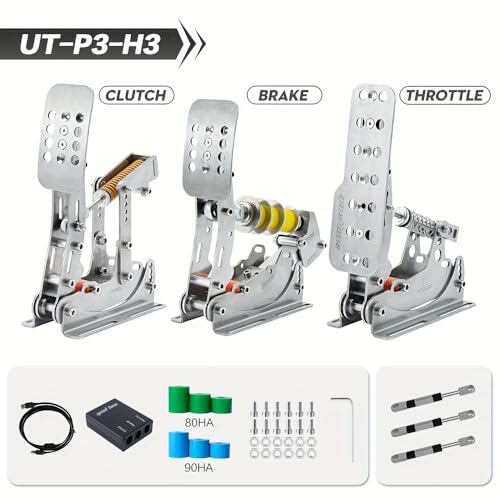
PC Tuning Pick – Simjack UT-P3-H3 Pedals
For PC racers comparing load cell pedals, the Simjack UT-P3-H3 offers a stated 200KG load cell brake, USB connection, and software for adjusting output curves and dead zones. Its listing describes throttle, brake, and clutch input, making it a configuration-focused option.
Best For: Windows PC sim racers who want pedal-curve tuning and a stated 200KG load cell brake.
Pros:
- Simjack Control supports output curves, dead zones, brake curves, and saved profiles.
- Listing specifies a 32-bit dual-core processor and 16-bit independent ADC for pedal inputs.
- Stainless-steel construction and multiple brake-damping rubber hardness options are described.
- Connects directly to a Windows PC by USB without driver installation, according to the listing.
Cons:
- The compatibility text says PC only and excludes PlayStation, Xbox, and Mac.
- Product details elsewhere conflict with that text by mentioning PlayStation 4 and wireless features; verify compatibility before purchasing.
This is the more adjustable choice here on paper, but the contradictory compatibility fields deserve a careful check if you plan to use anything other than a Windows PC.
Adjustable Two-Pedal Set – MOZA SRP2 Pedals
The MOZA SRP2 gives shoppers seeking load cell pedals a clearly identified brake-and-throttle set. Its stated 100KG load cell brake and 15-bit angle sensor are paired with adjustments for pedal angle, position, and height.
Best For: PC racers who want an adjustable two-pedal setup with a load cell brake.
Pros:
- Includes brake and throttle pedals, with a stated 100KG load cell brake.
- Pedal angle, position, and height are adjustable.
- CNC-machined aluminum, high-strength steel, enclosed sleeve motion, and polished shafts are specified.
- Connects directly to a PC via USB and is described as compatible with MOZA and most major third-party wheelbases.
Cons:
- No clutch pedal is identified as part of this two-pedal set.
- The supplied notes do not describe console compatibility.
If a brake-and-throttle layout fits your rig, the SRP2’s stated adjustability and direct PC connection make it a straightforward set to compare against other two-pedal options.
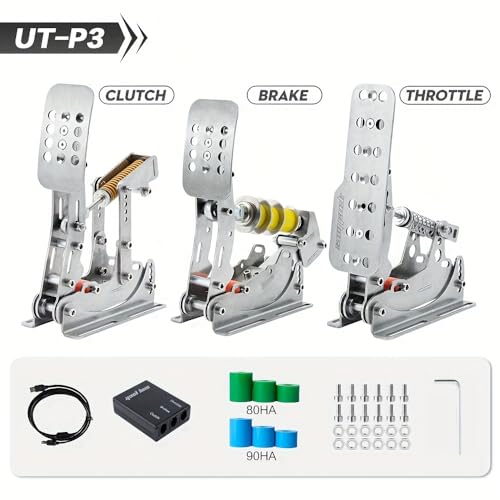
Three-Pedal Pick – Simjack UT-P3 PC Pedals
The Simjack UT-P3 is a PC-focused option for shoppers comparing load cell pedals and wanting throttle, brake, and clutch inputs. Its USB connection needs no driver installation, while Simjack Control lets you tune output curves and dead zones.
Best For: PC sim racers seeking a configurable three-pedal setup with a 200 kg load-cell brake.
Pros:
- Three-channel sampling covers throttle, brake, and clutch.
- Includes brake-damping rubber in three listed hardnesses: 60, 80, and 90.
- Stainless-steel construction includes a thickened 6 mm brake load-bearing section.
Cons:
- Not compatible with PlayStation, Xbox, or Mac.
- Requires a PC setup rather than a direct console connection.
Choose this UT-P3 listing if adjustable pedal response and a three-pedal layout matter more than console compatibility. Check its mounting fit against your rig before ordering.
H1 Variant – Simjack UT-P3-H1 Pedals
The UT-P3-H1 listing offers load cell pedals for PC racers who want a 200 kg-rated brake and software-adjustable response. It connects over USB without driver installation and is listed as shipping from a USA warehouse.
Best For: PC sim racers considering the UT-P3-H1 variant and wanting configurable throttle, brake, and clutch inputs.
Pros:
- Simjack Control supports output curves, brake curves, dead zones, and saved profiles.
- Three-channel simultaneous sampling covers throttle, brake, and clutch.
- Includes 60/80/90-hardness brake-damping rubber.
Cons:
- Does not work with PS4/PS5, Xbox, or Mac.
- The supplied description does not explain what the H1 designation adds over the standard UT-P3.
This is a sensible shortlist option if you want the listed H1 configuration and a PC-only USB setup. Confirm the exact included pedal hardware before buying rather than assuming the H1 suffix denotes a particular upgrade.
Two-Pedal Option – Simjack UT-P2 PC Pedals
The Simjack UT-P2 is the two-pedal model to consider when shopping for load cell pedals for a PC rig. Its listing specifies a 200 kg load-cell brake, USB plug-in setup without driver installation, and Simjack Control adjustments for pedal response.
Best For: PC racers who prefer a throttle-and-brake setup and do not need a clutch pedal.
Pros:
- Brake damping uses rubber with three listed hardness choices: 60, 80, and 90.
- Software supports output curves, brake curves, dead zones, and saved profiles.
- Steel construction includes a 6 mm thickened brake load-bearing section.
Cons:
- Not compatible with PlayStation, Xbox, or Mac.
- As the UT-P2 model, it is not the choice for buyers who need a three-pedal layout; verify package contents before purchase.
The UT-P2 is worth comparing with the UT-P3 listings if you have no need for a clutch. Its core appeal is adjustable PC pedal input without committing to a three-pedal configuration.
How We Picked These Load Cell Pedals
We focused on the practical differences that affect ownership: brake adjustability, pedal configuration, mounting demands, platform compatibility, and the clarity of each product listing. This selection includes ready-to-use sets and more DIY-oriented options. A stated kilogram rating alone did not determine where a set belongs: ratings may describe sensor capacity rather than the force you will comfortably apply at the pedal.
Quick Comparison: Where to Start
For a straightforward ecosystem purchase, start with the Logitech G RS, Fanatec CSL Elite V2, or MOZA sets, then confirm compatibility with your existing wheel and platform. The Asetek La Prima is worth considering if you have a dedicated PC rig and want a firm, rig-oriented setup. Simjack UT variants suit buyers willing to check exact configurations and spend time on mounting and tuning. The list contains two MOZA SRP2 listings and several Simjack UT variants; compare their included pedals and hardware rather than assuming each name represents a different tier.
Key Buying Factors for Load Cell Pedals
Brake Feel and Adjustability
Look for adjustment to brake resistance and usable travel, plus software options for setting the force needed to reach full braking. A heavier spring or elastomer is not automatically better. Choose a resistance you can repeat throughout a race without straining, and check what adjustment parts are included rather than advertised as optional extras.
Mounting and Space
Load Cell Pedals work best when the pedal base and your seat cannot move under braking. Check mounting-hole patterns, pedal-deck strength, and the space needed for pedal travel and cable routing. If you use a desk and rolling chair, plan for a stable mount and chair restraint before choosing a particularly stiff brake.
Compatibility and Package Contents
PC support does not guarantee console support. Console use may depend on a compatible wheelbase and its connection method, so verify the complete signal path with the manufacturer before buying. Check whether the listing includes two or three pedals, a clutch, control box, cables, mounting hardware, and any accessories shown in photos. This is especially important when comparing similarly named SRP2 and Simjack UT listings.
Who Should Buy Which Load Cell Pedals?
Choose a pedal set within your existing wheel ecosystem if simple integration is the priority. If you race on PC with a sturdy cockpit, put more weight on the brake feel and adjustability you prefer; Asetek and the configurable Simjack UT options are useful starting points. Consider MOZA if its available pedal configurations suit your budget and setup. Whichever you choose, verify the exact listing, total cost with any needed mount or accessories, and return terms before ordering.