
If you’re looking to spark creativity and learning in young minds, engineering toy kits can be a fantastic choice. These kits offer hands-on experiences that engage kids in various STEM concepts. From building bridges to creating robotic hands, there’s a kit for every budding engineer. But how do you choose the right one? Let’s explore some of the top options available and what factors to evaluate for the best fit.
Thames & Kosmos Structural Engineering Kit: Bridges & Skyscrapers

If you’re looking for a hands-on way to engage your kids in the fascinating world of engineering, the Thames & Kosmos Structural Engineering Kit: Bridges & Skyscrapers is a stellar choice. This science and engineering kit allows you to build 20 different models, sparking creativity and critical thinking. With over 285 interchangeable building pieces, your kids will experiment with concepts like force, load, compression, and tension. The illustrated 36-page manual guides you through each assembly, making it easy to understand. Plus, it’s an award-winning kit, recognized with a Parents’ Choice Gold Award, ensuring it’s both educational and fun!
Best For: Kids aged 8 and up who have an interest in engineering and enjoy hands-on building activities.
Pros:
- Encourages creativity and critical thinking through model building.
- Teaches fundamental engineering concepts in an engaging way.
- Award-winning kit, ensuring high educational value and quality.
Cons:
- Intermediate skill level may not be suitable for beginners.
- Some pieces may be small, posing a choking hazard for younger children.
- Requires adult supervision for younger users during assembly.
Smartivity DIY 2in1 Hydraulic Paper Airplanes & Darts Launcher STEM Toy for Kids
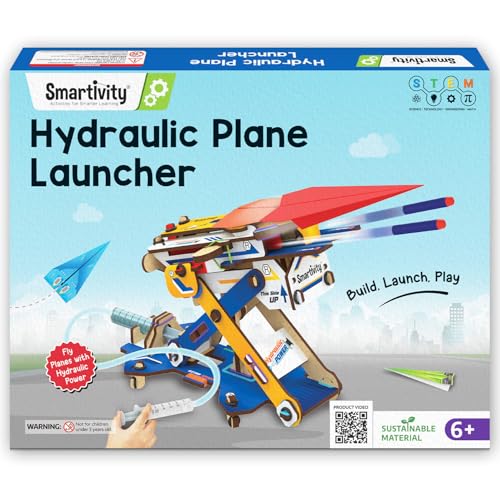
The Smartivity DIY 2in1 Hydraulic Paper Airplanes & Darts Launcher is the perfect choice for kids aged 6 to 14 who love hands-on activities and learning through play. This engaging mechanical toy allows you to launch paper airplanes and darts, making science fun and interactive. With a step-by-step manual, you’ll enjoy a rewarding DIY experience, boosting your creativity and confidence. Constructed from high-quality engineered wood, it’s safe and durable, and it comes with a lifetime supply of replacement parts. Recognized globally, this toy is an ideal gift that combines entertainment with education, promising hours of fun for everyone!
Best For: Kids aged 6 to 14 who enjoy hands-on activities and learning through play.
Pros:
- Encourages creativity and confidence while reducing screen time.
- Made from high-quality engineered wood for safety and durability.
- Provides a fun DIY experience with a lifetime supply of replacement parts.
Cons:
- Requires some assembly which may be challenging for younger kids.
- Limited to launching paper airplanes and darts, which may not appeal to all children.
- May require additional paper for launching, which is not included in the kit.
Snap Circuits Jr. SC-100 Electronics Exploration Kit for Kids

Designed for curious minds aged 8 and up, the Snap Circuits Jr. SC-100 Electronics Exploration Kit introduces you to the exciting world of electrical engineering. With over 100 projects and 28 easy-to-use parts, you’ll create electric-powered wonders, like a flying saucer that takes off and sounds an alarm. The user-friendly design means no extra tools or soldering are needed; the color-coded pieces snap effortlessly onto a grid. This award-winning kit makes a fantastic gift, promoting year-round learning and fun. Combine it with other Snap Circuits kits for even more creative possibilities! Immerse yourself and spark your engineering journey!
Best For: Children aged 8 and up who are curious about electrical engineering and enjoy hands-on learning experiences.
Pros:
- Engaging and educational, with over 100 projects to stimulate creativity and learning.
- User-friendly design that requires no special tools or soldering, making it accessible for beginners.
- Award-winning product recognized for its quality and educational value, making it a great gift option.
Cons:
- Batteries are required for operation, which may incur additional costs.
- Limited to the projects included in the kit unless combined with other Snap Circuits kits for more options.
- Some complexity in certain projects may require adult supervision or assistance.
Thames & Kosmos Roller Coaster Engineering STEM Kit
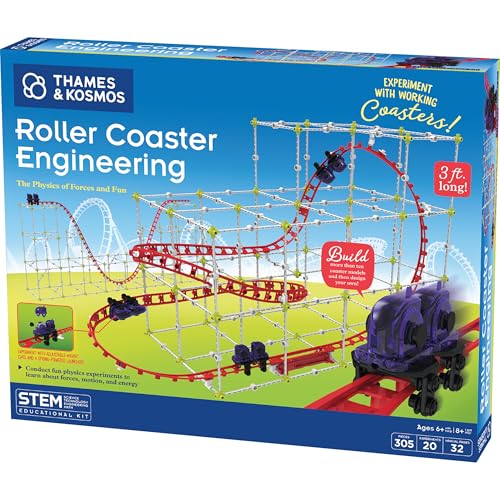
For young aspiring engineers and curious minds aged 6 to 18, the Thames & Kosmos Roller Coaster Engineering STEM Kit offers an exciting opportunity to explore the principles of physics through hands-on building. You’ll design and construct working roller coaster models using a durable, easy-to-assemble plastic system. The 32-page manual guides you with step-by-step instructions and scientific explanations. Engage in challenges like creating the tallest coaster or perfecting loop-de-loops while learning about forces, motion, and energy. With a 4.6-star rating from over 1,300 reviews, this kit promises endless fun and educational experiences for budding engineers.
Best For: Young aspiring engineers and curious minds aged 6 to 18 who are interested in physics and hands-on building activities.
Pros:
- Encourages practical learning through hands-on experiments and challenges.
- Comprehensive 32-page manual with clear instructions and scientific explanations.
- Modular building system allows for endless design possibilities and creativity.
Cons:
- May require adult supervision for younger users during assembly.
- Some users might find the complexity challenging without prior engineering experience.
- Limited to roller coaster designs, which may not appeal to all interests.
Smartivity DIY Robotic Mechanical Hand STEM Toy for Kids

Looking for an engaging way to spark your child’s interest in STEM? The Smartivity DIY Robotic Mechanical Hand is a fantastic choice for kids aged 8-14. This hands-on kit combines fun and education, encouraging creativity while reducing screen time. Crafted from high-quality engineered wood, it’s durable and safe for little hands. With a customer rating of 4.6 stars, it stands out as a top educational toy. The step-by-step manual makes assembly a breeze, ensuring hours of creative play. Plus, it’s a great gift, recognized globally and perfect for inspiring future engineers!
Best For: Kids aged 8-14 who are interested in hands-on STEM learning and creative play.
Pros:
- Encourages creativity and confidence through hands-on construction.
- Made from high-quality, durable materials ensuring safety for children.
- Recognized globally for its educational value and innovative design.
Cons:
- May require adult supervision during assembly for younger children.
- Some users might find the assembly instructions challenging without prior experience.
- Limited to a single project, which may not appeal to kids looking for variety.
ELEGOO UNO R3 Smart Robot Car Kit for Arduino Robotics

The ELEGOO UNO R3 Smart Robot Car Kit is ideal for young tech enthusiasts aged 8 to 16 who are keen to plunge into the world of programming and robotics. This STEM kit offers 24 modules, including obstacle avoidance and line tracing, ensuring hands-on learning. You’ll find the assembly straightforward, thanks to modified ports and an HD tutorial. With control options via Android and iOS, you can easily enhance your coding skills. Rated 4.6 stars, this kit not only promotes problem-solving but also fosters creativity, making it a top choice for budding engineers eager to explore robotics.
Best For: Young tech enthusiasts aged 8 to 16 who are eager to learn programming and robotics.
Pros:
- Encourages hands-on learning with 24 interactive modules, enhancing problem-solving and engineering skills.
- Simple assembly process with modified ports and an HD tutorial, making it accessible for beginners.
- Compatible with Android and iOS devices for easy control and programming.
Cons:
- Basic electronic knowledge is recommended, which may require additional guidance for inexperienced users.
- Some components may require careful handling to avoid assembly errors.
- Limited to users within the specified age range, which may exclude younger or older learners.
Robot Arm Kits for Kids and Teens STEM Toys

Designed specifically for kids and teens ages 8-16, Robot Arm Kits offer an engaging way to explore STEM education. You’ll plunge into robotics and circuits as you assemble motors, PCB microcontroller boards, and wires. This hands-on experience not only teaches physics and engineering principles, but also enhances your understanding of electronic circuits and mechanical movements. The cool wood building set, complete with a precise assembly tutorial, challenges your problem-solving skills and patience. Perfect as a gift or for educational use, these kits spark a lifelong interest in science and engineering for everyone aged 8 and up.
Best For: Kids and teens ages 8-16 who are interested in STEM education and robotics.
Pros:
- Encourages hands-on learning and enhances problem-solving skills.
- No soldering required, making it user-friendly for beginners.
- Ideal for educational settings and as a fun gift for various occasions.
Cons:
- May require adult supervision for younger users during assembly.
- Complexity might be challenging for some users without prior experience.
- Limited to a specific age range, which may not appeal to older teens or adults.
Butterfly EduFields 10-in-1 STEM Robotics Kit for Kids

For kids ages 8-14 who are curious about robotics and engineering, the Butterfly EduFields 10-in-1 STEM Robotics Kit offers an exciting hands-on experience. With over 100 components, including wires, switches, and LED lights, your child can build various robotic models in just 15 minutes. This kit enhances logical skills and critical thinking while engaging them in electronics and mechanics through fun DIY projects. The well-illustrated instruction manual makes assembly easy. It’s the perfect educational gift for birthdays or holidays, providing a playful way to explore scientific principles and hands-on learning in a creative manner.
Best For: Kids ages 8-14 who are interested in robotics and want to enhance their problem-solving skills through hands-on projects.
Pros:
- Encourages critical thinking and logical skills through engaging DIY robotics projects.
- Quick assembly time of around 15 minutes, making it easy for kids to start building right away.
- Comprehensive instruction manual allows for straightforward understanding and assembly of robotic models.
Cons:
- May require adult supervision for younger kids, especially if they are new to electronics.
- Limited to specific projects outlined in the kit, which may restrict creativity for some users.
- Components may be small and could pose a choking hazard for younger children if not monitored.
National Geographic Circuit Maker Kit for Kids

Looking for an engaging way to introduce your child to the wonders of electricity? The National Geographic Circuit Maker Kit for Kids offers over 120 electrical circuit projects that make learning fun. With hands-on experiments, your child will grasp essential concepts about how circuits work. They’ll create exciting activities like songs, light shows, and flying copters—all while exploring electrical possibilities. Safety’s a priority, too; the kit includes easy-to-follow illustrated instructions and video support via QR codes. Plus, it requires no additional tools, making it user-friendly. Let your child’s imagination soar with this award-winning educational experience!
Best For: This product is best for children aged 8 and up who are curious about electricity and enjoy hands-on learning experiences.
Pros:
- Engages children with over 120 fun and educational circuit projects.
- Safe and easy-to-use components with illustrated instructions and video support.
- Encourages creativity and imagination while learning essential electrical concepts.
Cons:
- May require adult supervision for younger children to ensure safety.
- Some projects may take longer to complete, which might test a child’s patience.
- Limited to electrical circuit projects, which may not appeal to all children.
STEM Robotics Kit for Kids Age 8-13

The STEM Robotics Kit captivates kids aged 8-13 with its diverse set of engaging toys, including a reptile robot and a bubble machine. With six STEM toy sets, your child can build robots and immerse themselves in DIY science projects, sparking curiosity in physics. It’s perfect for showcasing talents at science fairs, and parents can join in on the fun, creating memorable family moments. Packaged beautifully, this kit makes a unique gift for birthdays or Christmas, appealing to both boys and girls. Made from safe materials, it includes easy-to-follow instructions and a mini screwdriver for assembly. Get ready to inspire creativity!
Best For: Children aged 8-13 who have an interest in robotics and science, as well as families looking for engaging educational activities.
Pros:
- Encourages hands-on learning and exploration of STEM concepts through fun activities.
- Provides opportunities for family bonding and collaborative projects.
- Packaged as a gift, making it an attractive option for birthdays and holidays.
Cons:
- Requires additional materials like bubble solution and AA batteries, which are not included.
- May require adult supervision for assembly, which could limit independence for some kids.
- Target age range might not fully engage younger or older children outside of 8-13 years.
Factors to Consider When Choosing Engineering Toy Kits
When choosing engineering toy kits, you’ll want to take into account several key factors. Think about age appropriateness, as well as the educational value the kit offers. Also, pay attention to assembly complexity, material quality, and the variety of projects included to make sure it meets your needs.
Age Appropriateness
Choosing the right engineering toy kit involves considering the recommended age range, as these kits are crafted with specific developmental skills in mind. Many kits specify a minimum age, often starting at 6 years, reflecting the complexity of components and the cognitive skills needed for assembly. Age-appropriate kits guarantee safety and align with learning objectives, introducing basic physics for younger kids and more advanced concepts for older ones. As children grow, they develop stronger problem-solving and critical-thinking skills, so it’s essential to select kits that challenge them appropriately without causing frustration. Look for kits that offer varying skill levels, allowing your child to progress and deepen their understanding of engineering concepts as they gain experience.
Educational Value
Considering the educational value of engineering toy kits is essential for fostering a child’s interest in STEM subjects. These kits emphasize hands-on learning, helping kids understand scientific principles like force, load, and energy. With illustrated manuals, they guide your child through complex concepts, making it easier for them to grasp the material. As your child engages in building projects, they develop critical thinking, problem-solving skills, and creativity—key components of engineering education. Many kits cover a range of topics, from robotics to structural engineering, ensuring a thorough learning experience. Plus, working on projects together promotes collaboration and enhances social skills, reinforcing both educational concepts and family bonds. Choosing the right kit can greatly impact your child’s learning journey.
Assembly Complexity
As you explore engineering toy kits, assembly complexity plays a significant role in your selection process. Some kits are perfect for beginners, requiring minimal tools and straightforward instructions, while others demand advanced skills for intricate assembly. Look for kits with color-coded and numbered components; they simplify the process, making it accessible for younger or inexperienced users. If you’re considering intermediate to advanced kits, be prepared for multiple building challenges that require a deeper understanding of engineering principles. Step-by-step manuals can enhance your experience, guiding you through complex models and reducing frustration. Always keep the target age group in mind, as complexity is tailored to match the developmental skills and cognitive abilities of different ages.
Material Quality
Material quality is a crucial factor in selecting engineering toy kits, directly impacting both durability and safety. When you choose a kit, look for options made from high-quality engineered wood and non-toxic plastics, which guarantee that your child can play safely. Kits with a lifetime supply of replacement parts often use durable materials, extending playtime without the worry of breakage. Always verify that toys meet safety standards, using non-toxic, odorless substances to avoid health risks. Additionally, opt for kits that incorporate wear-resistant materials like reinforced plastics or metals, as these enhance longevity. Finally, consider the environmental impact—selecting toys made from sustainable materials promotes eco-friendliness and responsible consumption.
Project Variety
When selecting engineering toy kits, project variety plays a significant role in keeping kids engaged and enthusiastic to learn. A diverse range of projects lets children explore multiple engineering concepts, fueling their creativity and motivation. Look for kits that allow the creation of over 100 models, encouraging experimentation with different configurations. Projects encompassing physics, electronics, and mechanics provide a well-rounded educational experience, while varied challenges—like building roller coasters or robotic arms—help develop problem-solving skills and critical thinking. Additionally, kits that include step-by-step manuals for a wide array of projects make it easier for beginners to understand and successfully complete builds. This variety not only enhances learning but also keeps the fun alive in the building process.
Safety Features
Safety should be a top priority when choosing engineering toy kits for children. Verify the kits are made from non-toxic, high-quality materials to guarantee safe play. Look for products that meet safety standards and certifications, confirming they’ve been tested for harmful substances. It’s essential to check that components are free from sharp edges or small parts that could pose choking hazards, especially for younger kids. Kits with clear, easy-to-follow assembly instructions can help prevent accidents during building. Additionally, opt for toys that come with a warranty or a lifetime supply of replacement parts, assuring ongoing safety and usability. By considering these factors, you can provide a safe and enjoyable engineering experience for your child.