
If you’re looking to spark creativity and engineering skills in aspiring innovators, hobby robotics starter kits could be the key. These kits offer hands-on experiences, blending assembly with coding and mechanical design. With options catering to various ages and skill levels, choosing the right one can be challenging. Let’s explore some of the top kits available in 2026 and what makes them stand out in this ever-evolving field.
Thames & Kosmos Bionic Robotic Arm STEM Experiment Kit

If you’re looking for an engaging introduction to robotics for kids aged 10 and up, the Thames & Kosmos Bionic Robotic Arm STEM Experiment Kit is an excellent choice. With nearly 300 pieces, you’ll assemble a fully functional robotic arm that mimics real-world movements. Using joysticks, you can control its claw to open, close, and rotate 180 degrees. The kit includes a full-color manual packed with scientific information, making learning fun and interactive. You’ll develop essential skills like critical thinking and problem-solving, all while enjoying hands-on construction. It’s a fantastic way to spark a passion for STEM in young innovators!
Best For: The Thames & Kosmos Bionic Robotic Arm STEM Experiment Kit is best for kids aged 10 and up who are interested in robotics and hands-on learning experiences.
Pros:
- Engaging hands-on construction that fosters critical thinking and problem-solving skills.
- Full-color manual provides educational insights into robotics and engineering concepts.
- Intuitive joystick control allows for realistic movements of the robotic arm.
Cons:
- May require adult assistance for younger users aged 10-13.
- Assembly can be time-consuming due to the nearly 300 components.
- Not suitable for children under 10 without supervision, limiting accessibility for younger kids interested in robotics.
ELEGOO UNO R3 Smart Robot Car Kit for Arduino Robotics

The ELEGOO UNO R3 Smart Robot Car Kit is perfect for young enthusiasts aged 8 to 16 who are keen to plunge into the world of robotics and coding. This educational STEM kit includes 24 module parts like obstacle avoidance and line tracing modules, allowing you to build and program your own robot car. With HD instructions and support, you’ll easily assemble it, even if you’re a beginner. You can control it via your phone or tablet, making it fun and interactive. With a solid rating of 4.6 stars, it’s a fantastic choice for aspiring engineers and coders alike.
Best For: This product is best for young enthusiasts aged 8 to 16 who are interested in robotics and coding.
Pros:
- Engaging and educational STEM kit that promotes hands-on learning in robotics and programming.
- Includes a variety of modules for diverse functionalities, enhancing creativity and problem-solving skills.
- User-friendly assembly with HD instructions, making it suitable even for beginners.
Cons:
- Basic electronic knowledge is recommended, which may be a hurdle for complete beginners.
- Limited to certain mobile devices for control, which may exclude some users.
- The weight and dimensions might be less portable for some users.
ELEGOO Mega R3 Project Starter Kit Compatible with Arduino IDE

For budding engineers and hobbyists looking to immerse themselves in the world of robotics, the ELEGOO Mega R3 Project Starter Kit is an excellent choice. This kit includes over 200 premium quality components, ensuring you have everything you need to start your projects. With a MEGA2560 controller board and a variety of LEDs, resistors, and sensors, you’ll find endless possibilities for experimentation. Plus, the included PDF with 35 lessons makes learning easy and engaging. The kit’s thoughtful packaging, complete with an organizing box, enhances your experience, making it a top-rated option among users. Get ready to innovate!
Best For: Budding engineers and hobbyists eager to explore robotics and electronics through hands-on projects.
Pros:
- Comprehensive kit with over 200 high-quality components for diverse project possibilities.
- Includes a user-friendly PDF guide with 35 lessons to facilitate learning and experimentation.
- Thoughtful packaging with an organizing box enhances the overall customer experience.
Cons:
- Assembly is required, which may be challenging for complete beginners.
- Some users may find the kit’s weight (2.2 lbs) a bit cumbersome for portability.
- Limited advanced components may not satisfy experienced users looking for more complex projects.
Thames & Kosmos Robotics Workshop with Micro:Bit STEM Experiment Kit
Looking for an engaging way to introduce kids aged 8 months and older to the world of robotics and programming? The Thames & Kosmos Robotics Workshop with Micro:Bit STEM Experiment Kit is perfect for that! With 248 pieces, including motors and sensors, kids can build 14 motorized robots or create custom designs. Its user-friendly manual guides them through each step. They’ll learn coding through visual blocks, then advance to Python and JavaScript. This kit supports STEM education and is ideal for home or classroom use. Plus, it enjoys a solid 4.4-star rating from users, ensuring a fun, educational experience!
Best For: Kids aged 8 months and older who are interested in learning about robotics and programming in a fun and engaging way.
Pros:
- Encourages STEM education and develops critical thinking and problem-solving skills.
- Includes a comprehensive manual with step-by-step instructions for building multiple robots.
- Supports a progressive coding approach, starting with visual blocks and advancing to Python and JavaScript.
Cons:
- Might require adult supervision for younger children due to small parts.
- Some users may find the initial setup and coding challenging without prior experience.
- Limited to specific programming platforms, which may not appeal to all users.
ELEGOO UNO R3 Project Starter Kit Compatible with Arduino IDE

Ready to immerse yourself in the world of robotics? The ELEGOO UNO R3 Project Starter Kit is your perfect entry point. Compatible with Arduino IDE, it comes packed with over 200 components, including 63 types of Arduino products. You’ll find everything from a UNO R3 controller board to various sensors and motors. Plus, the kit includes an extensive PDF tutorial with 30+ lessons, ensuring you get started right. With a neat, compartmentalized case for organized storage, you can easily manage your projects. Rated 4.7 out of 5 stars, it’s a favorite among aspiring innovators. Jump in and release your creativity!
Best For: Beginners and hobbyists looking to explore robotics and electronics with a comprehensive starter kit.
Pros:
- Wide Range of Components: Over 200 components and 63 types of Arduino products included, offering diverse project possibilities.
- Educational Resources: Comes with a detailed PDF tutorial featuring 30+ lessons to aid learning and project development.
- Organized Storage: Compartmentalized case ensures easy organization and accessibility of components during projects.
Cons:
- Complexity for Absolute Beginners: May be overwhelming for those with no prior experience in electronics or programming.
- Limited Advanced Components: More advanced users may find the kit lacking in higher-end components or specialized modules.
- Dependency on Tutorials: Users reliant on the included tutorials may struggle with creativity and problem-solving in independent projects.
GAR Monster Starter Kit for Arduino – Robotics & IoT Development

The GAR Monster Starter Kit for Arduino is perfect for aspiring engineers and hobbyists enthusiastic to plunge into robotics and IoT development. This all-encompassing kit includes five main boards, such as the Uno R3 and ESP32, alongside over 25 sensor modules, enabling you to create smart home devices and remote-controlled robots. With no soldering required, you’ll find setup easy, aided by guides and tutorials accessible via a QR code. Organized in a durable toolbox, the kit holds over 65 components in pristine condition. Plus, GAR offers USA-based support and a lifetime replacement guarantee, ensuring your projects thrive.
Best For: Aspiring engineers and hobbyists eager to explore robotics and IoT development with a comprehensive and user-friendly kit.
Pros:
- Comprehensive Kit: Includes five main boards and over 25 sensor modules, providing extensive project possibilities.
- Easy Setup: No soldering is required, and setup is supported by accessible guides and tutorials.
- Lifetime Support: Comes with USA-based technical support and a lifetime replacement guarantee on all components.
Cons:
- Learning Curve: Beginners may still find some projects challenging without prior experience in electronics.
- Limited Advanced Features: While versatile, the kit may lack some advanced components found in more specialized kits.
- Bulkiness: The organized toolbox may be cumbersome for those with limited storage space.
Thames & Kosmos Dusty Robot Vacuum Cleaner STEM Kit

For young aspiring engineers and tech enthusiasts, the Thames & Kosmos Dusty Robot Vacuum Cleaner STEM Kit offers an engaging introduction to robotics. You’ll build a functional desktop robotic vacuum that cleans up dust and crumbs while learning about motors and gear trains. With smart navigation features, your Dusty can avoid obstacles and track edges, adding a fun twist to its tasks. The kit includes a thorough 52-page manual, making assembly simple and educational. Plus, its expressive personality makes cleaning entertaining! Weighing just 0.6 kilograms, it’s an ideal gift for curious minds aged 8 and up.
Best For: This product is best for young aspiring engineers and tech enthusiasts aged 8 and up who are interested in robotics and hands-on learning.
Pros:
- Engaging educational experience that teaches engineering concepts through assembly.
- Smart navigation features enhance playability by avoiding obstacles and tracking edges.
- Fun personality with changing facial expressions makes cleaning tasks entertaining.
Cons:
- Requires adult assistance for younger users, potentially limiting independent play.
- No batteries included, which may require additional purchases to operate.
- Limited to small debris and dust, may not be suitable for larger cleaning tasks.
ELEGOO UNO Project Super Starter Kit with UNO R3 Board
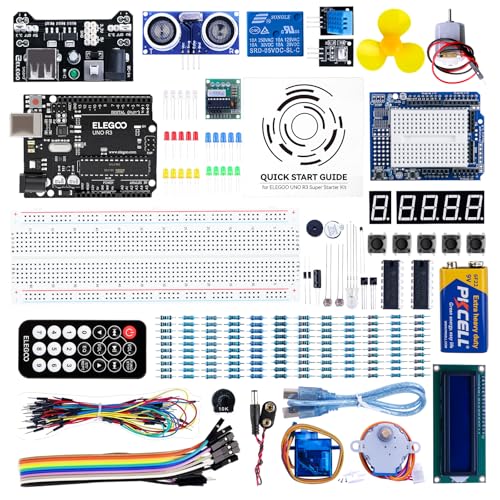
Ideal for beginners enthusiastic to plunge into the world of electronics, the ELEGOO UNO Project Super Starter Kit offers a broad package that includes everything you need to start building your own projects. Weighing just 1.2 pounds, this kit features an UNO R3 controller, LCD1602 module, various sensors, motors, and more. With 65 jumper wires and a detailed PDF tutorial of over 22 lessons, you’ll quickly grasp the basics of electronics. Rated 4.7 out of 5 stars by over 16,000 users, this kit guarantees a solid foundation in robotics and programming. Get ready to innovate and create!
Best For: Beginners eager to learn and experiment with electronics and programming through hands-on projects.
Pros:
- Comprehensive kit includes a wide range of components to facilitate learning.
- Detailed PDF tutorial with over 22 lessons makes it easy to follow for newcomers.
- Highly rated by users (4.7 out of 5 stars) indicates satisfaction and reliability.
Cons:
- Limited to projects compatible with Arduino IDE, which may restrict advanced users.
- The weight of 1.2 pounds may not be ideal for portability.
- Some components may require additional tools or parts not included in the kit.
Smartivity DIY Robotic Mechanical Hand STEM Toy for Kids

Looking for a fun and educational gift that sparks creativity? The Smartivity DIY Robotic Mechanical Hand STEM Toy is perfect for kids aged 8-14. This award-winning engineering kit encourages hands-on learning and reduces screen time while boosting confidence. With a step-by-step manual, your child will engage in exciting STEM activities, building their very own robotic hand. Made from high-quality, safe materials, it’s durable and comes with a lifetime supply of replacement parts. Trusted by families in over 33 countries, this toy has received rave reviews, ensuring it’s a great birthday gift for both boys and girls. Grab one today!
Best For: The Smartivity DIY Robotic Mechanical Hand STEM Toy is best for kids aged 8-14 who are interested in science, engineering, and hands-on activities.
Pros:
- Encourages creativity and confidence through hands-on building.
- Made from high-quality, safe materials with a lifetime supply of replacement parts.
- Highly rated by customers and recognized globally, making it a trusted educational toy.
Cons:
- May require adult supervision for younger children during assembly.
- Assembly can take time and may be challenging for some kids without assistance.
- Limited to a single project (the robotic hand), which may not appeal to all children.
Thames & Kosmos Smart Machines – Sidekick Robotics Kit

The Thames & Kosmos Smart Machines – Sidekick Robotics Kit is perfect for young aspiring engineers aged 8 and up who want to immerse themselves in the world of robotics and programming. You can build a 4-wheeled rover or a 2-wheeled robot, customizing it with LEDs, motors, and an infrared sensor. The kit includes a full-color manual to guide assembly and programming through a keypad or app. You’ll explore physics, engineering, and coding while controlling movements, sounds, and even dance routines. With rechargeable batteries and durable components, this kit is a fantastic way to spark creativity and problem-solving skills!
Best For: Young aspiring engineers aged 8 and up who want to explore robotics and programming through hands-on building and coding activities.
Pros:
- Engaging and educational, combining robotics with coding and problem-solving skills.
- Versatile design allows users to build both a 4-wheeled rover and a 2-wheeled robot.
- Comprehensive manual and app support make assembly and programming accessible for beginners.
Cons:
- Limited to basic robotics concepts, may not satisfy advanced learners.
- Customer reviews indicate mixed satisfaction, with an average rating of 3.5 stars.
- Requires assembly and programming, which may be challenging for some users without prior experience.
Factors to Consider When Choosing Hobby Robotics Starter Kits
When you’re choosing a hobby robotics starter kit, consider factors like age appropriateness and assembly complexity. Think about how the kit can help develop skills and the quality of the educational content it offers. Also, look for a variety of components to keep your projects engaging and versatile.
Age Appropriateness
Choosing the right hobby robotics starter kit hinges on age appropriateness, as many kits are designed for specific age groups, like 8-16 years or 10+ with adult help. Younger children thrive with kits featuring simple assembly and intuitive controls, while older kids and teens can tackle more complex programming and assembly tasks. Most kits include clear age recommendations and may suggest adult supervision for younger users to guarantee safety and engagement. When selecting a kit, consider not just the age range but also your child’s interests and prior experience in robotics. This way, you’ll find a kit that’s both engaging and educational, perfectly matching their cognitive and physical abilities.
Skill Development Opportunities
Finding a hobby robotics starter kit that fits your child’s age is just the beginning; considering skill development opportunities is equally important. Look for kits that emphasize hands-on building, as they enhance construction skills and dexterity. Many kits incorporate programming elements, allowing your child to develop coding skills and logical thinking while controlling robotic movements. Engaging with robotics also fosters critical thinking and problem-solving abilities, as kids troubleshoot and optimize their designs. Educational kits often introduce key STEM concepts, providing a solid foundation in mechanical engineering and electronics. Furthermore, participating in robotics projects encourages creativity and innovation, enabling your child to design custom solutions and explore real-world technology applications. Choose a kit that fuels their imagination and learning!
Assembly Complexity
While exploring hobby robotics starter kits, it’s crucial to contemplate assembly complexity, as it can greatly impact your child’s experience. Some kits require basic construction skills, while others feature intricate designs with many components. For beginners or younger users, kits with fewer pieces are often more manageable. On the other hand, kits boasting nearly 300 pieces may demand advanced skills and patience. Look for full-color, step-by-step guides, which can greatly aid in understanding assembly procedures. Additionally, kits utilizing intuitive control systems, like joysticks, can simplify wiring and coding. Finally, consider the recommended age range; products aimed at older kids or teens typically have more challenging assembly requirements, so choose wisely to guarantee a positive experience.
Educational Content Quality
After considering assembly complexity, the next important aspect is the educational content quality of hobby robotics starter kits. You’ll want kits that offer clear, step-by-step instructions along with theoretical knowledge to deepen your understanding of robotics and programming. Look for kits emphasizing real-world applications, like biomimicry, which can boost your critical thinking and problem-solving skills. Engaging tutorials, including video guides or interactive content, can greatly enhance your comprehension and retention. Additionally, thorough kits that introduce multiple coding languages, such as Python or JavaScript, prepare you for future tech challenges. Hands-on projects encourage experimentation, reinforcing your theoretical knowledge and fostering creativity in STEM education. Choose wisely to maximize your learning experience!
Component Variety
When exploring hobby robotics starter kits, component variety plays an essential role in your learning experience. A diverse range of components enhances your hands-on practice with sensors, motors, and mechanical parts. Kits that include multiple sensors, like ultrasonic and infrared, allow you to undertake more complex projects, helping you grasp different robotic functionalities. The mix of mechanical and electronic components, such as gears and microcontrollers, gives you a well-rounded understanding of how hardware and software work together. Educational kits with various modules let you experiment with features like obstacle avoidance and line tracing, fostering creativity and problem-solving skills. With an extensive array of components, you can easily customize projects and shift from simple builds to advanced robotics applications.
Programming Options Available
Choosing the right programming options is essential for your success in hobby robotics, as it directly impacts how effectively you can learn and create. Many starter kits feature visual block-based coding platforms that help you grasp programming concepts without any prior experience. As you progress, some kits introduce text-based languages like Python or JavaScript, allowing you to tackle more complex projects. You’ll also find kits that let you control your robot through mobile apps, making programming interactive and convenient. Integrated tutorials and step-by-step guides often accompany these kits, providing a structured learning path. With a range of programming environments available, from user-friendly interfaces to advanced IDEs, you can select a kit that matches your skill level and aspirations.
Support and Resources
Understanding programming options is just the beginning of your journey in hobby robotics; equally important is the support and resources that come with your starter kit. Look for kits that include thorough tutorials or manuals, as these are essential for guiding your assembly and programming efforts. Online resources, like video tutorials and cloud storage for guides, can greatly enhance your learning experience. It’s also wise to check for available customer service or technical support, as having assistance can help you troubleshoot issues during projects. A variety of components and modules in the kit allows for diverse projects, expanding your skills. Finally, read customer reviews to understand the effectiveness of the instructions and support provided.
Price Range Consideration
Hobby robotics starter kits can vary widely in price, typically ranging from around $30 to over $200. When you’re choosing a kit, think about the components and complexity. More affordable kits usually come with basic parts and limited functionalities, while pricier options often include advanced sensors and programming capabilities. Don’t forget to factor in additional costs for tools, batteries, or other materials that might not be part of the kit. Many kits also offer educational resources; those with extensive lesson plans or interactive tutorials can justify a higher price. Finally, check customer reviews and ratings to verify you’re getting good value and overall satisfaction within your chosen price range. This way, you’ll make a well-informed decision.