
As you explore the rapidly evolving world of automation, you’ll find that robotic arms with AI programming are at the forefront of this transformation. These innovative tools are not just for professionals; they’re designed for educators, hobbyists, and aspiring engineers, making advanced technology more accessible than ever. By understanding the unique features of each model, you can uncover how they can enhance your projects and learning experiences. What’s next in this exciting evolution?
Robotic Arm with Arduino 5DOF/Axis Educational Building Robotics Kit

The Robotic Arm with Arduino 5DOF/Axis Educational Building Robotics Kit is perfect for budding engineers and educators looking to plunge into the world of robotics. Built on the Atmega328 platform, it’s fully compatible with Arduino programming, offering open-source software and valuable tutorials. This kit features a 6-channel knob controller, Bluetooth module, and high-precision digital servos, ensuring precise movements. You can easily expand its functionality with various sensors like the ESP32 Cam or ultrasonic sensor. With app control and real-time knob adjustments, you’ll enjoy versatile, hands-on learning experiences that make robotics exciting and accessible.
Best For: This product is best for educators, students, and hobbyists eager to explore robotics and programming through hands-on learning.
Pros:
- Open-source compatibility allows for easy programming and customization using Arduino.
- Versatile control options enable both app and real-time knob adjustments for enhanced user experience.
- Expandable functionality with various sensors unlocks creative potential for diverse robotics projects.
Cons:
- Limited range of built-in sensors may require additional purchases for more complex projects.
- Learning curve associated with programming and sensor integration might be challenging for complete beginners.
- Requires assembly which may not be suitable for users looking for a plug-and-play solution.
Robotic Arm AI Vision Voice Control for Arduino STEM Project
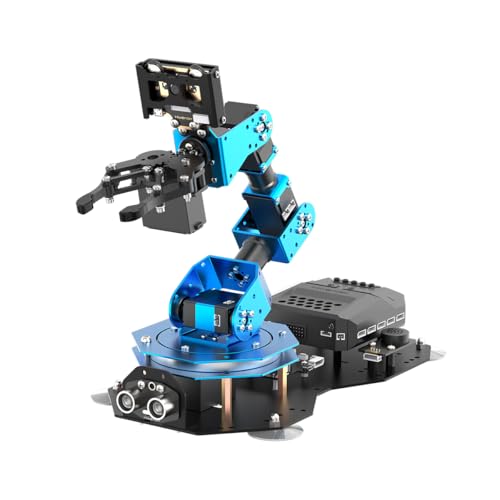
If you’re a student or a beginner enthusiastic to plunge into the world of artificial intelligence, the Robotic Arm AI Vision Voice Control project is perfect for you. You’ll learn programming with Arduino, Scratch, or Python through detailed tutorials. This project features the WonderCam AI vision module for color recognition and facial tracking, plus the WonderEcho voice module for broadcasting commands. With intelligent serial bus servos and advanced inverse kinematics algorithms, your arm will execute complex tasks smoothly. Powered by the CoreX Controller, it’s compatible with Hiwonder sensors, making it an ideal hands-on experience in AI education while honing your coding skills.
Best For: Students and beginners eager to explore artificial intelligence and robotics through hands-on learning experiences.
Pros:
- Comprehensive tutorials available for mastering programming in Arduino, Scratch, and Python.
- Equipped with advanced AI vision and voice interaction modules for enhanced interactivity.
- Smooth execution of complex tasks thanks to intelligent servos and inverse kinematics.
Cons:
- May require additional components for full functionality beyond the base kit.
- Limited to specific programming languages, which may not cater to all learners’ preferences.
- Some users may find the initial setup and programming challenging without prior experience.
Robotic Arm for Arduino AI Vision & Voice Interaction (LeArm AI Standard Kit)

For aspiring engineers and hobbyists looking to immerse themselves in the world of robotics, the Robotic Arm for Arduino AI Vision & Voice Interaction (LeArm AI Standard Kit) is an ideal choice. This 6DOF serial bus servo smart robot arm is powered by ESP32 and fully compatible with Arduino programming. You’ll love its built-in Bluetooth and multiple expansion ports for upgrades. With support for AI vision, voice commands, and various sensors, it allows for exciting applications like color recognition and face detection. Plus, with over 200 tutorials and sample projects, you’ll quickly learn AI and programming while fostering your creativity.
Best For: Aspiring engineers and hobbyists eager to explore robotics and programming through hands-on projects.
Pros:
- Versatile Control Options: Easily controlled via app, PC software, or wireless controller, making it beginner-friendly.
- Comprehensive Learning Resources: Comes with over 200 tutorials and sample projects, aiding in AI and programming education.
- Advanced Features: Equipped with AI vision and voice interaction capabilities, enabling innovative applications like color recognition and target tracking.
Cons:
- Complexity for Advanced Users: While beginner-friendly, more experienced users may find it lacks advanced features for complex projects.
- Dependency on Software: Performance can be limited by the capabilities of the app or software used for control.
- Potential for Hardware Upgrades: Some users may need to purchase additional sensors or components for enhanced functionality, which could increase overall costs.
Robotic Arm Kit 6DOF for Arduino STEM Education
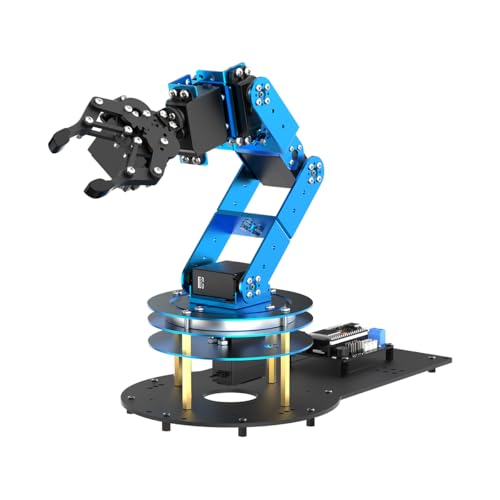
Designed specifically for students and aspiring engineers, the Robotic Arm Kit 6DOF offers an engaging hands-on experience in STEM education. With six servos and a mechanical claw, you’ll immerse yourself in the world of robotics effortlessly. Its open-source design and Arduino compatibility make programming a breeze, whether you’re using an app, PC software, or a wireless controller. You’ll appreciate the precise movements provided by the advanced inverse kinematics algorithm. Plus, expand your learning with various sensors for AI vision and voice control. With over 200 tutorials and sample experiments available, you’ll gain valuable skills in AI and programming.
Best For: Students, aspiring engineers, and robotics enthusiasts looking to gain hands-on experience in STEM education.
Pros:
- Open-source design allows for customization and flexibility in programming.
- Comprehensive learning resources with over 200 tutorials and sample experiments to support users of all skill levels.
- Versatile sensor compatibility enables a wide range of applications, enhancing the learning experience.
Cons:
- Setup may require time for beginners to become familiar with the components and programming.
- Limited advanced features compared to higher-end robotic kits, which may not satisfy experienced users.
- Potential for complexity when integrating multiple sensors, which could overwhelm novice users.
ArmPi Ultra Robotic Arm with ROS2 AI Models

The ArmPi Ultra Robotic Arm with ROS2 AI Models is perfect for enthusiasts and students aged 16 and up who want to plunge into the world of robotics and AI programming. Weighing just 5 pounds and measuring 11 x 7 x 18 inches, it’s compact yet powerful. With six 25KG intelligent servos, it delivers precise motion control. You’ll enjoy applications like object tracking and intelligent sorting, enhanced by its high-performance RGB-D camera. Plus, the included voice interaction via WonderEcho AI lets you engage multimodally. Extensive tutorials and resources make mastering ROS development and AI effortless, ensuring you develop valuable skills.
Best For: The ArmPi Ultra Robotic Arm is best for robotics enthusiasts and students aged 16 and up who are keen on exploring AI programming and robotics development.
Pros:
- High Precision: Equipped with six 25KG intelligent servos for accurate motion control.
- Versatile Applications: Supports various tasks such as object tracking, intelligent sorting, and 3D grabbing.
- Comprehensive Learning Resources: Comes with extensive tutorials and guides to aid in mastering robotics and AI concepts.
Cons:
- Age Restriction: Recommended for individuals aged 16 and up, limiting accessibility for younger learners.
- Weight: At 5 pounds, it may be somewhat cumbersome for younger users to handle.
- Complexity: The advanced features may require a learning curve for beginners in robotics and AI.
Robot Hand with Arduino Open Source AI Bionic Robotic Hand Kit

If you’re looking for a hands-on way to immerse yourself in robotics and programming, the Robot Hand with Arduino Open Source AI Bionic Robotic Hand Kit is perfect for you. This five-finger mechanical arm allows you to explore DIY robotics, featuring an open-source platform compatible with Arduino. It includes a range of sensors and components, like a Bluetooth module and anti-blocking servos, encouraging creativity and expansion. With real-time control options and wireless glove capabilities, you can easily customize your projects. Weighing just 2.4 pounds, it’s designed for ages 17 and up, making it an exciting educational tool for aspiring engineers.
Best For: This product is best for aspiring engineers and robotics enthusiasts aged 17 and up who want to explore hands-on programming and DIY projects.
Pros:
- Open Source: Compatible with Arduino programming, providing flexibility for customization and learning.
- Versatile Control Options: Supports both app control and wireless glove control for dynamic interaction.
- Expansion Capabilities: Includes multiple expansion ports for sensor integration, encouraging creativity in robotic projects.
Cons:
- Limited Customer Ratings: With a 3.4 out of 5 stars rating, some users may have concerns about quality or usability.
- Age Restriction: Recommended for ages 17 and up, which may limit accessibility for younger learners.
- Starter Kit Exclusions: The standard kit does not include some sensors and modules that could enhance the experience.
Robotic Arm with Arduino 5DOF/Axis – STEM Educational Building Kit

For aspiring engineers and tech enthusiasts, the Robotic Arm with Arduino 5DOF/Axis offers an engaging way to explore robotics and programming. This open-source STEM kit is built on the Atmega328 platform, making it compatible with Arduino programming. You’ll enjoy high-precision digital servos and a 6-channel knob controller, allowing for precise movements. The kit supports various sensors, enabling secondary development for advanced features like sonic ranging. With options for app control and real-time knob control, you can easily customize your projects. Whether you’re a beginner or more experienced, this kit is perfect for enhancing your skills in robotics and engineering.
Best For: This product is best for aspiring engineers and tech enthusiasts looking to enhance their skills in robotics and programming.
Pros:
- Open-source compatibility with Arduino programming allows for easy customization and development.
- High-precision digital servos and a 6-channel knob controller ensure accurate movements and control.
- Supports various sensors for advanced features, enabling secondary development and enhanced project capabilities.
Cons:
- Limited to 5DOF/Axis, which may not suit projects requiring more advanced robotic capabilities.
- Initial learning curve for beginners who may find programming and integration challenging.
- Basic starter kit may lack additional components needed for more complex projects, requiring further investment.
AI Vision & Voice Interaction Smart Robot Dog Kit (MechDog Pro)
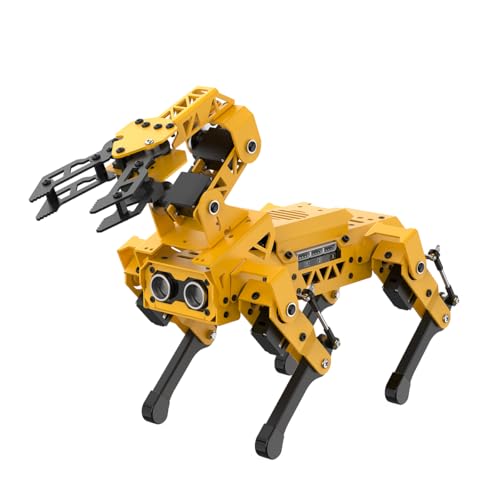
Designed specifically for students and beginners in artificial intelligence, MechDog Pro offers an engaging way to explore robotics and programming. This smart robot dog simulates a real pet, allowing you to engage in mechanics, electronics, and automation. With its 3DOF mini-robot arm and eight high-speed servos, you’ll enjoy precise movements and autonomous object handling. You can control it via PC or mobile apps, programming in Python, Scratch, or Arduino. Plus, its AI vision and voice interaction features enhance interactivity, sparking creativity and enabling diverse projects. MechDog Pro is a versatile educational tool that paves the way for future innovations in AI.
Best For: MechDog Pro is best for students and beginners interested in learning about artificial intelligence, robotics, and programming.
Pros:
- Engaging and interactive design simulates a real pet, making learning enjoyable.
- Offers multiple programming options (Python, Scratch, Arduino) for diverse skill levels.
- Built-in AI features enhance user engagement and encourage creative project development.
Cons:
- May require some prior knowledge in programming for effective use.
- Initial setup and configuration could be challenging for complete beginners.
- Limited advanced functionalities compared to more sophisticated robotics kits.
Robotic Arm for Arduino AI Vision Voice Interaction 6DOF
The Robotic Arm for Arduino AI Vision Voice Interaction 6DOF is perfect for budding engineers and hobbyists keen to explore robotics, programming, and artificial intelligence. This kit features a 6DOF robotic arm controlled by an ESP32, fully compatible with Arduino. With advanced inverse kinematics, it guarantees precise movements and path planning. You’ll enjoy experimenting with AI vision and voice control, utilizing sensors for color recognition and face detection. Multiple control options, including app and PC software, make it user-friendly. Plus, the extensive educational resources help you learn and innovate, making this kit an ideal starting point for your robotics journey.
Best For: This product is best for beginners and hobbyists interested in robotics, programming, and artificial intelligence.
Pros:
- Offers a comprehensive learning experience with over 200 tutorials and open-source resources.
- Equipped with advanced features like AI vision and voice control for interactive projects.
- Multiple control options, including app and PC software, provide flexibility and ease of use.
Cons:
- May require a learning curve for complete beginners unfamiliar with robotics or programming.
- Limited to the capabilities of the included sensors and servos, which may restrict advanced projects.
- Some users might find the initial setup time-consuming compared to simpler kits.
HIWONDER ROS2 ChatGPT Robotic Arm Kit

HIWONDER’s ROS2 ChatGPT Robotic Arm Kit stands out as an ideal choice for educators and hobbyists enthusiastic to explore the intersection of robotics and artificial intelligence. With its flexible design and powerful Jetson Nano options, this 6DOF arm integrates advanced AI capabilities for complex projects. Equipped with a high-performance 3D depth camera and multimodal AI models, it excels in perception tasks like object sorting and target tracking. Plus, the included tutorials guide you through ROS development, OpenCV, and voice interaction, making it a fantastic resource for anyone looking to engage in AI-powered robotics.
Best For: Educators and hobbyists interested in exploring robotics and artificial intelligence through hands-on projects.
Pros:
- Advanced AI Integration: Equipped with deep learning frameworks and multimodal AI models for complex tasks.
- Comprehensive Learning Resources: Includes tutorials on ROS development, computer vision, and voice interaction.
- Enhanced Perception Capabilities: Features a high-performance 3D depth camera for improved object interaction and spatial awareness.
Cons:
- Complexity for Beginners: May be challenging for those with no prior experience in robotics or programming.
- Limited Hardware Options: The dependence on specific Jetson Nano models may restrict customization.
- Potential Setup Time: Initial setup and configuration could take time and require technical knowledge.
Factors to Consider When Choosing Robotic Arms With AI Programming
When you’re choosing robotic arms with AI programming, consider key factors that impact your project’s success. You’ll want to look at programming language compatibility, sensor integration options, and the control methods available. Additionally, think about the educational resources provided and the motion precision and control that fit your needs.
Programming Language Compatibility
How can you guarantee your robotic arm meets your programming needs? First, check if it supports popular programming languages like Arduino, Python, or Scratch. This compatibility can greatly ease your learning curve and project development. Also, opt for models that work well with open-source programming environments; this flexibility allows you to modify and enhance functionalities as needed. Look for platforms offering extensive tutorials and sample codes in the supported languages, which can accelerate your skill development. If you’re interested in advanced features like AI integration, make sure you’re familiar with the necessary libraries or frameworks. Finally, choose a robotic arm that aligns with your educational goals, especially if you want to explore areas like AI vision or voice interaction.
Sensor Integration Options
Choosing the right robotic arm isn’t just about programming language compatibility; sensor integration plays an essential role in expanding its capabilities. Many robotic arms support various sensors like cameras, ultrasonic sensors, and accelerometers, enhancing functionality for diverse tasks. Integrating AI vision modules enables tasks such as color recognition, facial detection, and object tracking, boosting interactivity. Look for multiple expansion ports on robotic arms, which allow you to add sensors and customize your projects. Additionally, consider integrating voice interaction modules for improved user engagement through voice commands. Advanced sensors like depth cameras can elevate performance, enabling complex actions such as 3D grabbing and precise distance measurement in dynamic environments. This flexibility can greatly elevate your automation projects.
Control Methods Available
While selecting a robotic arm with AI programming, it’s crucial to take into account the various control methods available, as they can greatly influence your user experience. Many robotic arms offer multiple control options like app control, PC software, and wireless controllers, so you can choose what suits you best. Some models even allow real-time control with knob potentiometers, giving you immediate responses for a more interactive experience. Plus, you can program these arms using languages like Arduino, Python, or Scratch, which caters to your coding skills. Advanced features such as offline action editing let you pre-program sequences without constant input, while compatibility with AI modules can enhance functionalities like voice interaction and AI vision for sophisticated task execution.
Educational Resources Provided
When you’re considering robotic arms with AI programming, the availability of educational resources can make a significant difference in your learning experience. Many educational robotic arms come with over 200 tutorials and sample experiments, helping you grasp AI and programming concepts effectively. You’ll often find open-source code and well-commented programs, enabling you to modify and experiment with the arm’s functionality. Additionally, these kits typically include circuit schematics to simplify understanding of the electronics and mechanics involved. Extensive support materials, like step-by-step guides and video tutorials, help you master robotics and AI development. Best of all, some models are designed to be beginner-friendly, allowing you to immerse yourself in learning without prior experience.
Motion Precision and Control
Motion precision and control are critical factors to evaluate for anyone looking to harness the full potential of robotic arms with AI programming. You’ll want to contemplate the type of servos used; high-torque intelligent serial bus servos offer superior control and responsiveness for complex tasks. Advanced algorithms, like inverse kinematics, enable precise path planning, ensuring smooth and accurate movements. Integrating sensors such as AI vision and ultrasonic sensors greatly enhances a robotic arm’s environmental perception, leading to improved motion accuracy. Real-time control options, including app and PC software interfaces, allow you to make immediate adjustments, boosting precision. Finally, the number of degrees of freedom (DOF) directly affects the arm’s capability to perform intricate tasks, so choose wisely.
Expansion Capabilities
As you explore the capabilities of robotic arms with AI programming, considering expansion options becomes crucial. Look for models that allow integration of various sensors like AI vision, ultrasonic, and accelerometers. These features enhance functionality and project versatility. Many robotic arms come equipped with multiple expansion ports, enabling you to add new components and improve performance. Verify compatibility with open-source programming platforms, such as Arduino, to simplify the development of custom sensors and modules. Additionally, check if the robotic arm supports various control methods, including app and PC software, allowing you flexibility in interaction. Finally, take advantage of extensive learning resources like tutorials and sample codes to maximize your robotic arm’s expansion capabilities effectively.
User Experience Level
How do you determine the right robotic arm with AI programming for your experience level? If you’re a beginner, choose arms with thorough tutorials and open-source programming options to help you grasp coding and robotics basics. For intermediate users, look for features like inverse kinematics and multiple sensor integration to boost your projects. If you’re advanced, opt for robotic arms that support complex programming languages like Python and are compatible with deep learning frameworks for sophisticated AI applications. Control options matter too; simpler interfaces suit novices, while PC software and advanced programming cater to experienced users. Don’t overlook educational resources—ample tutorials and sample projects are essential for enriching your understanding of robotics and AI concepts.